
 400-0559-095
 中文/EN
中文/ENIndustrial Application Quadruped Robot
Industrial inspection often requires access to large, complex, and potentially hazardous environments. Power plants, tunnels, mines, and other industrial sites may contain uneven terrain, confined spaces, and equipment that requires regular monitoring. Sending workers into every inspection area can make routine patrols more difficult and increase their exposure to operational risks.
Industrial inspection robots offer a practical alternative for these conditions. With four-legged mobility and integrated sensing capabilities, they can navigate challenging terrain, collect inspection data, and support remote monitoring. This guide explains the key benefits of quadruped robots for industrial site inspection and the situations where they can provide the greatest value.

Traditional inspection programs become more difficult to scale as industrial facilities grow larger and more complex. Expanding inspection coverage often requires more personnel, additional training, and more time spent in environments that may be difficult or hazardous to access. As a result, maintaining both inspection efficiency and worker safety becomes increasingly challenging.
Manual inspection can require workers to enter confined spaces, areas with poor air quality, and unstable structures. Power tunnels, mine shafts, and industrial vaults are examples of environments where limited access and potential hazards make routine inspection more challenging.
Sending a robot into these areas first allows operators to collect visual and environmental data remotely, reducing the need for immediate human exposure to hazardous conditions.
Routine inspection often requires technicians to follow the same routes and check the same equipment repeatedly. As facilities expand, maintaining consistent inspection schedules becomes more difficult because staffing levels, travel time, and manual processes can all affect inspection quality.
Quadruped robots can repeatedly follow predefined inspection routes and collect standardized data, helping improve inspection consistency while supporting long-term monitoring across large industrial sites.
Industrial inspection robots provide several advantages that make them well suited for site inspection. Their key benefits include:
l Improved safety by reducing the need for workers to enter hazardous areas.
l Greater mobility across stairs, uneven terrain, slopes, and obstacles.
l Higher efficiency through consistent inspection routes and remote data collection.
Together, these capabilities help organizations improve both inspection safety and operational efficiency while maintaining more consistent inspection coverage.
Enhanced Inspection Safety
Quadruped robots improve inspection safety by taking on the physical risk that used to fall on a person. Instead of a technician entering a tunnel to check for gas buildup, a robot equipped with gas sensors and thermal cameras goes in first and reports back.
As a result, workers only enter a space once the robot's data confirms it is safe, or not at all if the robot finishes the task on its own. This single change is why utilities and mining operators list safety as their leading reason for adopting the technology.
Four-legged mobility improves site accessibility because a quadruped chassis steps over obstacles that stop a wheeled unit cold. DEEP Robotics' X30, for example, climbs stairs and slopes up to 45 degrees and crosses obstacles up to 20cm high.
The chassis is also sealed to an IP67 rating, meaning full dust protection and resistance to temporary water immersion. Wheeled robots need flat, cleared paths, and drones cannot operate for long in tight underground corridors, so legs solve both problems at once.
Industrial inspection robots support efficient inspection through autonomous navigation, auto-charging, and real-time data upload that together form a closed-loop workflow. A single operator can oversee several routes instead of walking each one personally.
Therefore, the labor cost per inspection round drops even as the frequency of inspection increases. The clearest advantages of quadruped robots in industrial inspection show up when they are compared directly against the other mobile platforms facilities already use.
Capability | Quadruped Robot | Wheeled Robot | Aerial Drone |
Stairs and uneven terrain | Climbs slopes and steps | Requires flat, cleared paths | Not applicable |
Confined tunnel navigation | Fits narrow, low corridors | Struggles with debris | Limited by rotor clearance |
Weather resistance | IP66/IP67 rated for rain and dust | Varies by model | Grounded in high wind or rain |
Continuous operation | 2.5-4h per charge, quick battery swap | Similar to quadruped | Typically under 30 minutes |
Best-fit environment | Mixed or rough terrain, stairs | Flat industrial floors | Open-air, above-ground surveys |
Industrial inspection robots are used across a wide range of industrial environments, including power and utilities, underground tunnels, mining, construction, and hazard rescue. While each application has different requirements, they all benefit from the robot's mobility, remote operation, and sensing capabilities.
· Power and utilities: Inspect substations and transmission infrastructure without requiring personnel to approach live equipment.
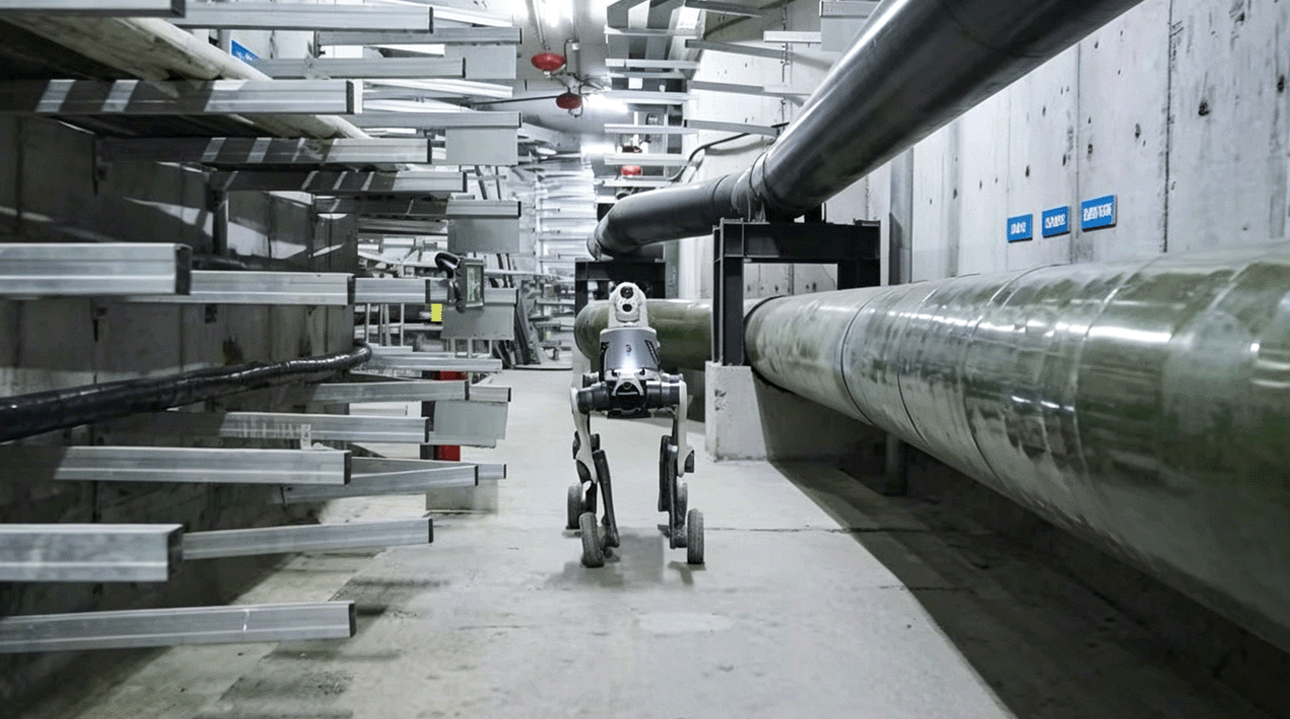
· Underground tunnels: Monitor cable tunnels for structural or environmental issues during routine patrols.
· Mining: Navigate narrow, dusty, or uneven areas to reduce the need for manual inspections.
· Construction: Support site surveying, progress monitoring, and repetitive inspection tasks.
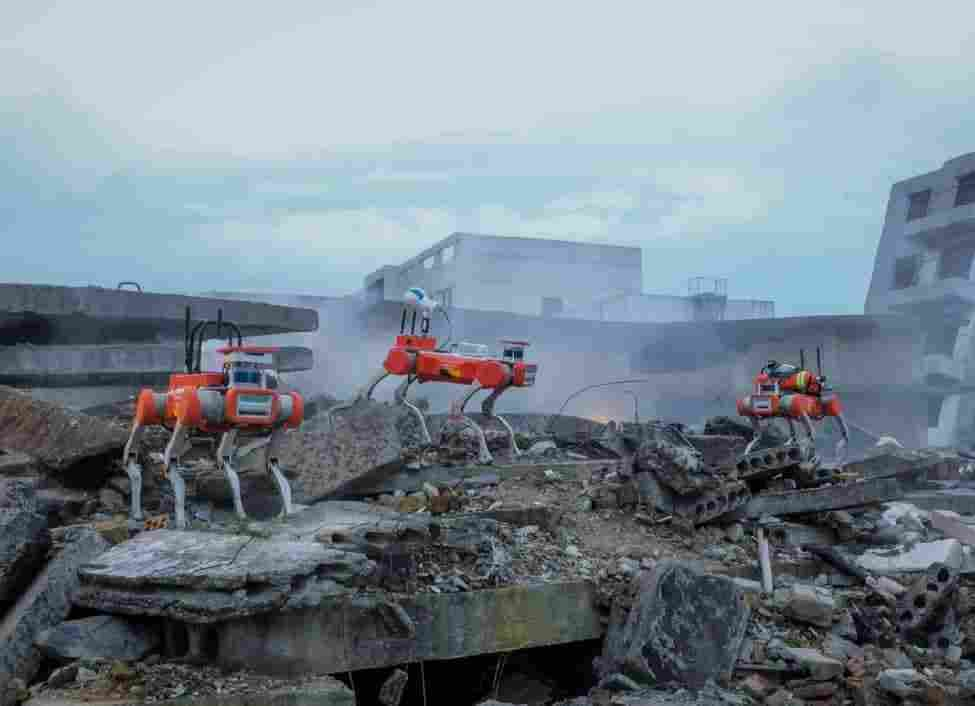
· Hazard rescue: Carry cameras and sensors into hazardous areas to assess conditions before responders enter.
Among the companies developing industrial quadruped robots, DEEP Robotics provides solutions for power utilities, industrial inspection, surveying, and security. Its X30 is designed for environments that demand reliable mobility, sensing, and autonomous inspection capabilities.

The X30's published specifications give a useful baseline for evaluating its fit for industrial inspection. These figures come directly from DEEP Robotics' product page and describe laboratory testing conditions; real-world results may vary depending on terrain and task.
Spec | Value |
Operating temperature | -20°C to 55°C |
Ingress protection | IP67 |
Max speed | ≥4 m/s |
Slope climbing | ≤45° |
Obstacle height | ≥20 cm |
Endurance | 2.5-4h, quick battery swap |
Mileage per charge | ≥10 km |
Weight | 56kg (battery included) |
SP Group deployed a customized DEEP Robotics X30 quadruped robot, named “SPock,” to support inspections in Singapore’s underground power transmission tunnels. The robot uses high-resolution cameras and thermal sensors to patrol sections of the tunnel network and identify issues such as cracks, water seepage, and other abnormalities.
This deployment demonstrates how quadruped robots can support infrastructure inspection by collecting data in difficult-to-access environments while reducing the need for frequent manual patrols. According to DEEP Robotics, the solution is expected to save approximately 480 hours of manual inspection time annually.

Industrial inspection robots make the most sense for sites where inspection routes involve confined spaces, rough terrain, or hazards that should not be routine for a person to face. Facilities running tunnels, substations, mines, or large construction sites tend to see the clearest return.
Smaller, fully indoor facilities with flat floors and no hazardous zones may not need the full capability of a quadruped platform, since a simpler wheeled unit could cover the same ground at lower cost.
The right starting point is usually a single high-risk route, tested with DEEP Robotics' quadruped robot lineup, before expanding coverage further.

 Wechat
 Bilibili
 LinkedIn
 Youtube
 Twitter
 Douyin







 浙公网安备:33010602009611